How Spanish Borrowed Meaning from Indigenous Textile Cultures
Spanish didn’t replace Indigenous cultures; it absorbed them.
That absorption didn’t just happen through food, place names, or traditions. It happened through meaning. And some of the most powerful meanings of Spanish absorbed came from Indigenous textile cultures that had been communicating identity, history, and hierarchy long before the Spanish ever arrived.
I love this topic for adult Spanish learners because it answers a question many people quietly wonder: Why does Spanish sound so different depending on where you are? The answer isn’t randomness. It’s history, and a lot of it is woven.


Before Spanish, There Was Already Meaning
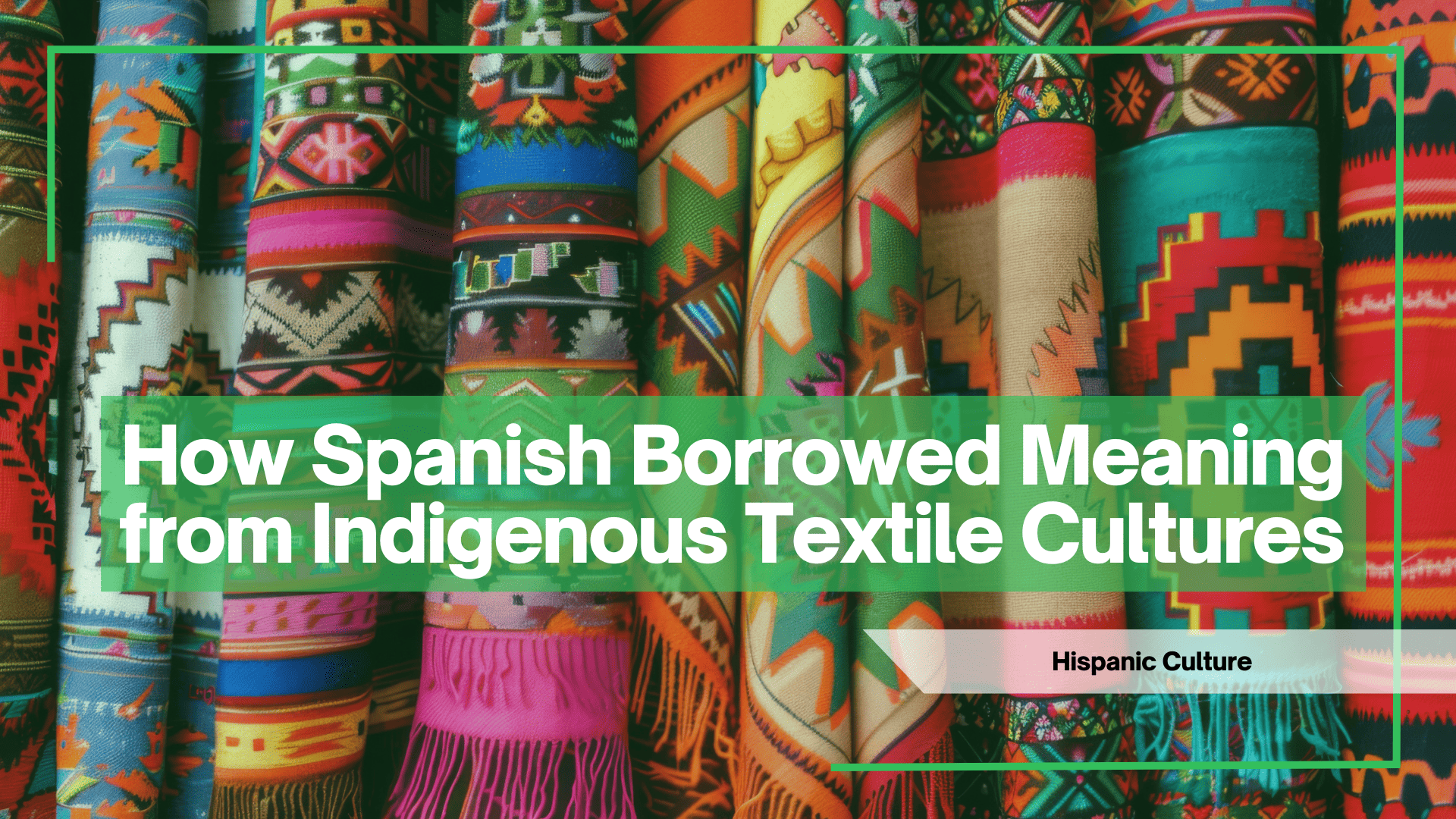
Across Latin America, Indigenous societies used textiles as structured systems of communication. Colors, patterns, materials, and placement weren’t decorative choices; they carried shared meaning.
According to the United Nations, more than 370 million Indigenous people worldwide belong to over 5,000 distinct cultures, many of which relied on oral and material systems—such as textiles—to transmit knowledge rather than alphabetic writing.
When Spanish arrived, it didn’t enter a blank slate. It encountered cultures that already “spoke” fluently through symbols.
Spanish adapted.
How Meaning Transfers from Textiles to Language
When Spanish speakers interacted with Indigenous communities, they didn’t just borrow words. They absorbed ways of categorizing the world.
Here’s how textile cultures influenced the Spanish across regions:
- Loanwords rooted in daily life: Many Spanish words for clothing, tools, and agriculture come directly from Indigenous languages tied to textile-producing cultures
- Visual specificity: Spanish in many regions favors detailed, descriptive language, mirroring the visual storytelling of textiles
- Symbolic references: Colors, patterns, and materials often appear in metaphors and expressions
Linguists estimate that thousands of Indigenous-origin words entered Spanish across the Americas, especially in areas with strong textile traditions. These words weren’t replaced because Spanish lacked vocabulary; they stayed because they carried meaning Spanish alone didn’t have.
Why Spanish Isn’t Uniform (and Never Was)
One of the biggest frustrations for intermediate learners is discovering that Spanish doesn’t behave the same everywhere. Vocabulary changes. Expressions shift. Even rhythm and emphasis feel different.
Understanding Indigenous influence helps explain why.
In regions with strong textile cultures—like parts of Mexico, Guatemala, Peru, and Bolivia—Spanish absorbed local ways of organizing meaning. That’s why certain words exist in one country and not another, or why the same concept is described differently depending on place.
Spanish didn’t flatten culture. It layered over it.
For learners, this realization is empowering. Instead of chasing a single “correct” Spanish, you start listening for regional logic.
What This Means for Listening and Comprehension
Advanced comprehension isn’t about knowing more words; it’s about recognizing patterns of meaning.
When you know that Spanish in Latin America carries Indigenous influence, you become a better listener. You stop expecting direct translation and start paying attention to:
- Context over literal phrasing
- Descriptive language choices
- Cultural references tied to place and history
This shift often unlocks a new level of fluency for adult learners who already understand grammar but want conversations to feel more natural.
Textiles as Cultural Memory
Textile traditions didn’t just influence Spanish centuries ago; they continue to shape how language is used today.
Millions of Indigenous artisans across Latin America still practice traditional weaving, often using techniques passed down for hundreds of years. These practices preserve systems of meaning that continue to influence identity, storytelling, and expression.
A More Generous View of Spanish
When learners understand that Spanish absorbed meaning from Indigenous cultures, something important changes.
Mistakes feel less intimidating. Variations feel logical. And Spanish stops feeling like a rigid system you must master and starts feeling like a living language shaped by many voices.
That perspective supports exactly what adult learners want: confidence, flexibility, and cultural fluency.
Spanish sounds different across regions because it is different by design, by history, and by human creativity. And once you hear that, you’re no longer just learning Spanish. You’re learning how meaning travels.
Join one of the 40,000 classes that we teach each month and you can experience results like these

“It’s great being able to interact with native speaking people and having a conversation with them not just doing all the work on paper. It’s also an amazing opportunity to speak with native Spanish-speaking people without having to travel to a native Spanish-speaking country.”
– Melanie

“Getting to know wonderful teachers who care about me and my growth in language and education. Evelyn Gomez and Erick Cacao are two of the most extraordinary people I have ever met, and talking with them in Spanish at the beginning of classes is always so fulfilling and greatly contributes to my happiness, joy, and wellbeing.”
– Abby

“I love that my children have the opportunity to speak with a live person. They get to practice Spanish in a 1-1 setting while improve their speaking, writing and reading skills during their lessons. HSA is a great way to learn Spanish for all ages! My children are 6, 9 and 11. My oldest two (9 and 11) have been taking classes with HSA for almost 2 years now. They love seeing their teacher each week. They understand the importance of learning several languages. I’ve seen them grow and learn with HSA. I’m excited to see how they will improve the more classes they take. I highly recommend them. You can’t bet learning and speaking with a live teacher. I’ve tried other programs. It’s just not as motivating.”
– Karie Ann, Parent of 3
Want to Learn More about Hispanic Culture? Check These Out!
- From Jaguars to Llamas: 25 Animal Words That Build Real Spanish Sentences for Middle Schoolers
- What Easter and Spring Traditions in Spanish-Speaking Countries Can Teach Your Teen (Beyond Vocabulary)
- Why So Many Latin American Desserts Are Served Warm (and Why Kids Love That)
- From Arroz con Leche to Natilla: The Spanish Preschoolers Learn at the Table
- Why Some Latin American Desserts Are Less Sweet, and What That Teaches Kids About Taste
- Spicy Food Traditions Across Latin America (And How Families Talk About Them)
- Why Spicy Food Is a Family Language in Latin America, And What Kids Learn From It
- What Valentine’s Day Teaches Advanced Learners About Sounding Natural in Spanish