From Songs to Sentences: The Spanish Activities That Still Work at the Next Level
When my daughter started forming full sentences in Spanish, I was over the moon, but also a little unsure what to do next. She had mastered colors, numbers, and animals, and could sing every Spanish song we’d played on repeat for months. But I started to wonder: Now what?
If you’re in the same spot, wondering how to build on the progress your preschooler has made, you’re not alone. You’ve invested time in play-based learning, and it’s paid off. The good news? You don’t have to start over or switch to drills and worksheets. You just need to level up the activities your child already enjoys.
Here’s how to take those fun, foundational tools—songs, games, stories—and give them an intermediate twist that keeps your child engaged and growing in Spanish.

Why Play Still Matters at the Intermediate Level
At the preschool stage, play isn’t just a break from learning; it is the learning. According to the American Academy of Pediatrics, play enhances brain structure, supports executive functioning, and improves language acquisition through meaningful, low-pressure interaction.
But as your child moves from single words to full thoughts in Spanish, it’s important to evolve your approach. That doesn’t mean losing the fun. It means adding more depth, more conversation, and more context to what your child already loves.
5 Spanish Activities That Grow with Your Child
1. Upgrade the Songs: From Lyrics to Conversations
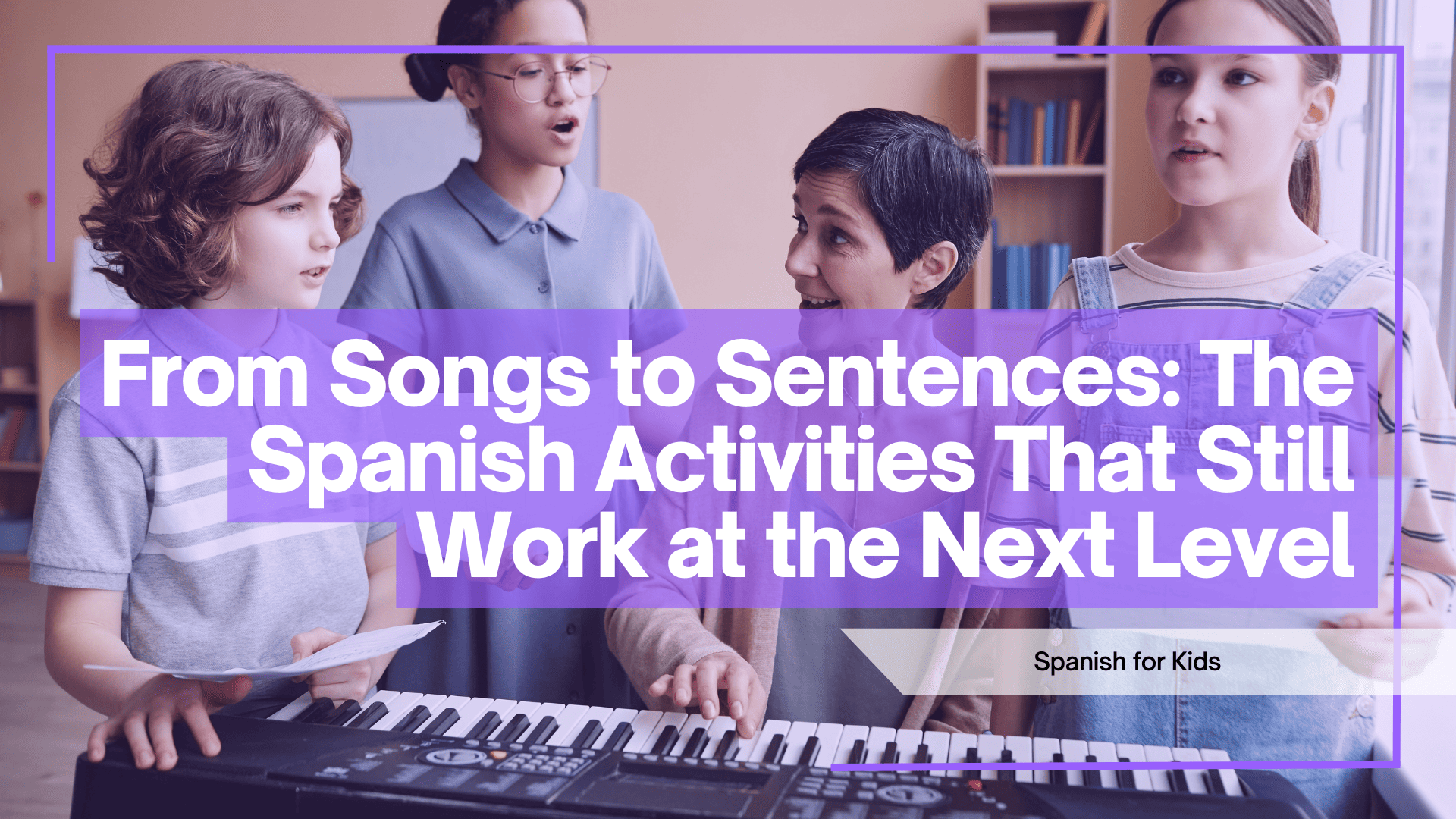
Singing is still powerful—but now’s the time to talk about the songs too. Choose ones with a storyline (like Los Pollitos Dicen or Un elefante se balanceaba) and use them as conversation starters.
Try questions like:
- ¿Qué hace el pollito cuando tiene frío?
- ¿Cuántos elefantes había al principio?
This builds comprehension and turns passive listening into active language use.
2. Story Time with a Twist: Add Retelling and Role Play
Your child probably already loves Spanish storybooks. Now, try pausing to ask.
- ¿Qué crees que va a pasar?
- ¿Cómo se siente este personaje?
Then, invite your child to retell the story in their own words or act it out with puppets. This will stretch their vocabulary and help with sentence formation.
3. Bilingual Scavenger Hunts: Add Descriptions and Challenges
A beginner scavenger hunt might involve finding things by color (Busca algo rojo). At the intermediate level, ask your child to describe what they find:
- Encontré una pelota. Es redonda y azul. Sirve para jugar.
You can also add tasks:
- Busca algo que se usa para cocinar.
- Encuentra algo que tenga cuatro patas.
This builds functional vocabulary and grammar naturally.
4. Create a “Spanish Show-and-Tell” Routine
Give your child a day each week to bring something to a “class” (even if it’s just you!) and present it in Spanish:
- Este es mi dinosaurio. Se llama Max. Tiene dientes grandes y le gusta correr.
This blends creativity with real-life communication and builds confidence like nothing else.
5. Turn Everyday Routines into Dialogue Practice
Daily habits—getting dressed, cooking, brushing teeth—offer opportunities for full-sentence practice. Instead of labeling items (cepillo = toothbrush), model and encourage full phrases:
- Voy a cepillarme los dientes.
- ¿Puedes pasarme la toalla, por favor?
With repetition, these become natural expressions your child can use on their own.
Ready to Go Further?
At Homeschool Spanish Academy, we specialize in helping children move from beginner to intermediate and beyond. Our 1-on-1 online classes are designed to grow with your child, using a play-based curriculum that adapts to their level. Every lesson is led by a native Spanish-speaking teacher who knows how to make language both fun and effective.
Curious if our lessons are a good fit? Click here to book a free trial class and see how we help kids expand their vocabulary and confidence, one sentence at a time.
Keep What Works, Just Take It Deeper
The transition from beginner to intermediate Spanish doesn’t mean leaving the songs and stories behind. It means using them in a richer, more interactive way. With a few small tweaks, you can help your child express more ideas, ask more questions, and feel proud of their growing fluency.
You’ve built a strong foundation. Now let’s keep going together.
Join one of the 40,000 classes that we teach each month and you can experience results like these

“It’s great being able to interact with native speaking people and having a conversation with them not just doing all the work on paper. It’s also an amazing opportunity to speak with native Spanish-speaking people without having to travel to a native Spanish-speaking country.”
– Melanie

“Getting to know wonderful teachers who care about me and my growth in language and education. Evelyn Gomez and Erick Cacao are two of the most extraordinary people I have ever met, and talking with them in Spanish at the beginning of classes is always so fulfilling and greatly contributes to my happiness, joy, and wellbeing.”
– Abby

“I love that my children have the opportunity to speak with a live person. They get to practice Spanish in a 1-1 setting while improve their speaking, writing and reading skills during their lessons. HSA is a great way to learn Spanish for all ages! My children are 6, 9 and 11. My oldest two (9 and 11) have been taking classes with HSA for almost 2 years now. They love seeing their teacher each week. They understand the importance of learning several languages. I’ve seen them grow and learn with HSA. I’m excited to see how they will improve the more classes they take. I highly recommend them. You can’t bet learning and speaking with a live teacher. I’ve tried other programs. It’s just not as motivating.”
– Karie Ann, Parent of 3
Want more free Spanish Resources for Kids? Check these out!
- “Te Quiero” vs. “Te Amo”: The Valentine’s Mistake Advanced Learners Still Make
- The Spanish Your Child Never Learns in School—But Hears in Every Sports Interview
- Snow Day Spanish: Fun Indoor Activities That Build Real Fluency
- Christmas Desserts Around the World: Sweet Spanish Vocabulary Every Middle Schooler Will Love
- Christmas in Latin America: Advanced Vocabulary for Real Cultural Fluency
- Woodland Wonders: Learn Spanish Animal Words from the Forest
- Mini Scientists en Español: Easy Experiments That Teach Spanish Words
- First Spanish Books for Middle Schoolers: Build Literacy and Confidence Fast

- Valentine’s Day Is One of the Best Times to Practice Advanced Spanish Conversation - February 15, 2026
- “Te Quiero” vs. “Te Amo”: The Valentine’s Mistake Advanced Learners Still Make - February 14, 2026
- Spanish Word Order for Simple Sentences (Kids Included) - February 13, 2026