Talking About Taste in Spanish: The Words Kids Need Beyond ‘Spicy’
If everything is just “spicy,” conversations stop too soon.
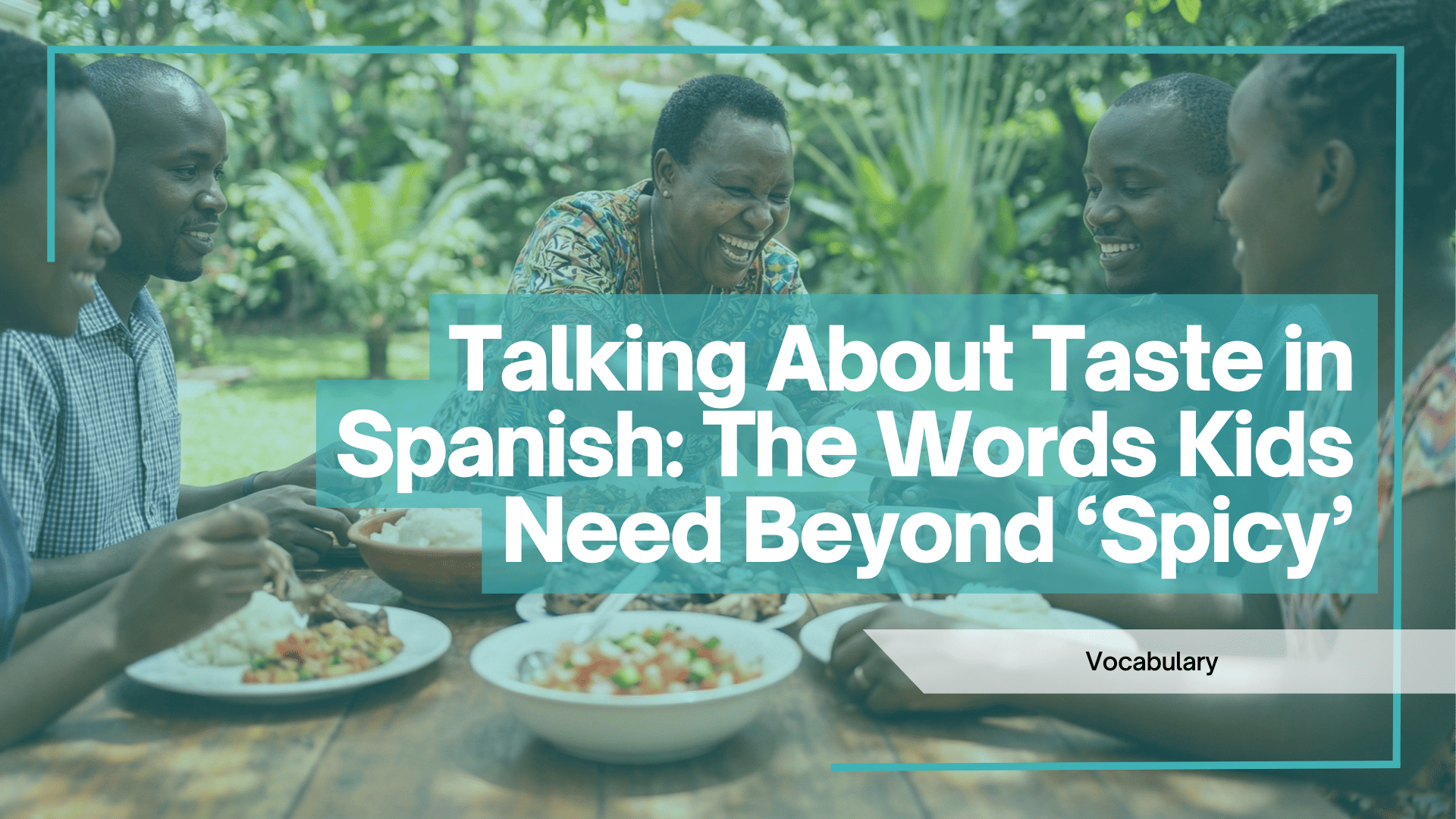
I’ve watched it happen so many times at family meals: a plate is passed, a bite is taken, someone asks how it tastes, and the answer is a single word: picante. End of exchange. For kids who already speak some Spanish, that one-word reply can quietly shut down what could have been a warm, connecting moment.
The good news is that moving beyond “spicy” doesn’t require advanced grammar or fancy vocabulary. It requires the right words: descriptive, human words that families actually use when they talk about food. And for intermediate learners, this is one of the easiest ways to sound more expressive and confident right away.


Why Taste Words Matter So Much in Family Spanish
In many Latin American families, talking about food is talking about feelings. Flavor opens the door to opinions, memories, and gentle teasing. According to the Pew Research Center, food ranks among the top cultural markers for Hispanic identity, which explains why so much conversation happens around the table.
When kids can only say whether something is spicy or not, they miss the chance to participate fully. But when they can describe how something tastes, conversations naturally expand.
What Happens When Kids Have More Words
When children add descriptive language to their Spanish, three things happen almost immediately:
- They give longer answers, which invite follow-up questions
- They sound more natural and less rehearsed
- They feel more comfortable joining ongoing conversations
Research on language acquisition consistently shows that lexical diversity—using a wider range of words—correlates strongly with perceived fluency, even when grammar is imperfect. In other words, sounding fluent often starts with choosing better words, not knowing more rules.
Taste Words Kids Actually Need (Beyond “Spicy”)
Here’s a short list of high-impact words and phrases families use all the time. These are practical, conversational upgrades your child can use immediately:
- Suave – mild or gentle
- Fuerte – strong, intense
- Ahumado – smoky
- Dulce – sweet
- Salado – salty
- Amargo – bitter
- Ácido – tangy or sour
- Bien condimentado – well seasoned
- Tiene buen sabor – it tastes good
- Está pesado – it feels heavy
Notice that none of these are complicated. But each one opens the door to more interaction. Saying “está fuerte pero rico” invites a response. Saying “me gusta el sabor, pero pica un poco” keeps the conversation going.
How This Changes the Family Dynamic
When kids use descriptive language, adults respond differently. Relatives explain ingredients. They share preferences. They tell stories. And suddenly, Spanish becomes a shared experience rather than a test.
This matters because intermediate learners often go quiet, not from lack of knowledge, but from fear of saying the wrong thing. Giving them flexible, descriptive phrases reduces that pressure.
ACTFL emphasizes that communicative competence depends on the ability to negotiate meaning in real contexts, and food conversations are one of the safest places to practice that skill.
Helping Your Child Practice Before the Table
Of course, knowing the words isn’t enough. Kids need chances to use them aloud, with feedback, in a low-pressure setting. That’s where guided conversation makes a real difference.
When children practice describing taste with a teacher and another student, they learn to:
- Elaborate instead of giving one-word answers
- React naturally to follow-up questions
- Adjust their language based on the response
Those skills transfer directly to family meals.
At Homeschool Spanish Academy, we focus on helping students move from functional Spanish to expressive Spanish—so conversations don’t stall at “spicy.” You can see how this approach works by trying a free Spanish class and watching your child practice real, meaningful conversation.
Because when your child can talk about taste with confidence, they’re not just describing food; they’re joining the family story.
Join one of the 40,000 classes that we teach each month and you can experience results like these

“It’s great being able to interact with native speaking people and having a conversation with them not just doing all the work on paper. It’s also an amazing opportunity to speak with native Spanish-speaking people without having to travel to a native Spanish-speaking country.”
– Melanie

“Getting to know wonderful teachers who care about me and my growth in language and education. Evelyn Gomez and Erick Cacao are two of the most extraordinary people I have ever met, and talking with them in Spanish at the beginning of classes is always so fulfilling and greatly contributes to my happiness, joy, and wellbeing.”
– Abby

“I love that my children have the opportunity to speak with a live person. They get to practice Spanish in a 1-1 setting while improve their speaking, writing and reading skills during their lessons. HSA is a great way to learn Spanish for all ages! My children are 6, 9 and 11. My oldest two (9 and 11) have been taking classes with HSA for almost 2 years now. They love seeing their teacher each week. They understand the importance of learning several languages. I’ve seen them grow and learn with HSA. I’m excited to see how they will improve the more classes they take. I highly recommend them. You can’t bet learning and speaking with a live teacher. I’ve tried other programs. It’s just not as motivating.”
– Karie Ann, Parent of 3
Want to Learn More Spanish Vocabulary Resources? Check These Out!
- Te Quiero vs Te Amo: Don’t Say the Wrong ‘I Love You’ in Spanish
- How To Write Dates in Spanish
- The Most Common Spanish Words Beginners Need
- The Cutest Spanish Pet Names for Couples (With Meanings)
- From ‘El Perro’ to Full Conversations: Teaching Kids to Describe Animals in Spanish Naturally
- 10 Fascinating Animals from Latin America That Make Spanish Easier to Learn (Yes, Really)
- From ‘Hola’ to High School Credit: A Spring Plan for Beginner Spanish Learners
- Semana Santa Across Latin America: The Words Your Teen Needs to Understand Cultural Differences

- Top-Rated Online Spanish Programs for Children - September 8, 2026
- 1-on-1 Online Spanish Tutors for Kids: How to Choose the Best Program for Your Child - September 1, 2026
- Accredited Online High School Spanish Courses for Credit: How to Choose the Right Program - August 25, 2026