Spanish Winter Words for Preschoolers
Brrrr! The temperatures are freezing and heavy snowfall has convinced your family to stay indoors (until it’s time to make a snowman, of course). Christmas songs and hot chocolate breaks have made their way into your daily routine. Invierno (winter) is here and in full swing. Looks like it’s time to start learning some Spanish winter words! With the flurry of excitement that your preschooler feels for the holidays, you can channel it into activities and lessons that teach enjoyable nouns, verbs, and useful phrases. ¡Disfrutemos el invierno!
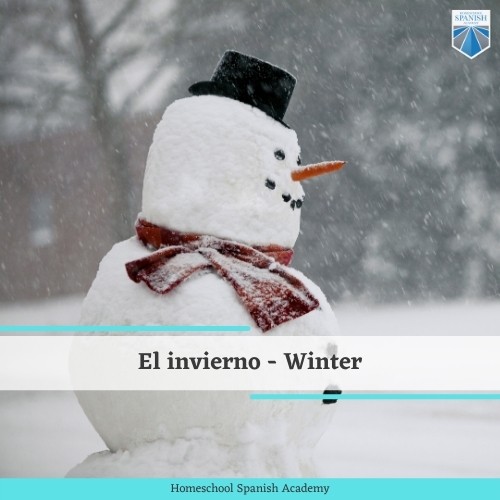
Winter Words
This versatile theme gives you the perfect excuse to teach different categories of words, such as singular and plural nouns as well as verbs and verb phrases. Here is our list of the most common and useful winter words in Spanish with a helpful pronunciation guide:
| Spanish | English | Pronunciation |
| Afuera | Outside | Ah-fwer-ah |
| Nieve | Snow | Nyeh-vay |
| El copo de nieve | Snowflake | Koh-poh day nyeh-vay |
| El muñeco de nieve | Snowman | Moon-yeh-koh day nyeh-vay |
| El hielo | Ice | Yel-oh |
| Los patines de hielo | Iceskates | Pah-tee-nehs day yel-oh |
| Los Esquis | Skis | Eh-SKEES |
| El trineo | Sled | Tree-nay-oh |
| El invierno | Winter | Een-VYER-noh |
| tener frío | To be cold | Tay-nehr free-oh |
| Ropa | Clothing | Roh-pah |
| Los guantes | Gloves | Wahn-tays |
| La bufanda | Scarf | Boo-fahn-dah |
| El gorro | Hat | Goh-rroh (roll your r’s!) |
| Las botas | Boots | Boh-tahs |
| El abrigo | Coat | Ah-bree-goh |
| El suéter | Sweater | Sway-tehr |
| Las manoplas (la manopla) | Mittens (one mitten) | Mee-TOH-nays |
| Símbolos de navidad | Christmas symbols | Seem-boh-lohs day nah-vee-dad |
| La chimenea | Chimney | Chee-mee-nay-ah |
| El regalo | Present | Ray-gah-loh |
| El árbol de navidad | Christmas tree | Ar-BOHL day nah-vee-dad |
| Los renos | Reindeer | Ray-nohs |
| Bebidas calientes | Hot drinks | Bay-bee-dahs cah-lee-yen-tays |
| El chocolate caliente | Hot chocolate | Choh-koh-lah-tay cah-lee-yen-tay |
| El ponche de huevo | Eggnog | Pohn-chay day way-voh |
Vocabulary Lessons
Storytime
An excellent way to help your little one learn new words is by using them in a story. When the words come to life in a creative way, it builds context and memorable associations that enhance your child’s ability to retain new vocabulary. Implementing any number of reading strategies or activities to accompany your story will increase the effectiveness and add lots of extra fun.
Flashcards
Flashcards are the simplest way to teach new vocabulary. Enjoy our exclusive Homeschool Spanish Academy Winter Theme Flashcards as a must-have learning tool! Be sure to laminate them for durability. See what else you can do with flashcards here.
Download FREE Spanish Winter Words Flashcards
Type in your name and email below! We’ll immediately send this awesome set of Spanish Winter Words Flashcards to your inbox!
Extended Lesson Ideas
By using Winter as your central theme, you can build on it with endless sub-topics to include grammar instruction and practice of previously learned skills. Examples, such as single and plural nouns, the gender of nouns, new verbs and how to conjugate them, and question words like ¿dónde? and ¿cuántos? can easily be incorporated into this theme. For extra practice of previous lessons, add some color activities, counting games, and use opposite words to describe your new collection of wonderful wintry words.
Here are some examples that you can continue to enhance with your own ideas:
Colors
El suéter azul – the blue sweater
El gorro verde – the green hat
¿Qué color es el trineo? – What color is the sled?
El trineo es rojo. – The sled is red.
Counting
Una manopla – one mitten
Cuatro renos – four reindeer
¿Cuántos guantes tienes? – how many gloves do you have?
Tengo dos guantes. – I have two gloves.
Opposites
Las botas secas / las botas mojadas – dry boots / wet boots
Chocolate caliente / chocolate frio – hot chocolate / cold chocolate
El muñeco de nieve delgado / el muñeco de nieve gordo – skinny snowman / fat snowman
¿Dónde está el árbol de navidad? – Where is the Christmas tree?
El árbol de navidad está cerca. / El árbol de navidad está lejos. – The Christmas tree is nearby / The Christmas tree is far away.
More Examples to Consider:
| Verb | Statement | Question |
| Tener – to have / to be | Tengo mis guantes (I have my gloves) | ¿Tienes tus guantes? (Do you have your gloves?) |
| Tener frío – to be cold | Tengo frío (I am cold) | ¿Tienes frío? (Are you cold?) |
| Tener calor – to be hot | Tengo calor (I am hot) | ¿Tienes calor? (Are you hot?) |
| Estar – to be | Estoy en la nieve (I’m in the snow) | ¿Estás en la nieve? (Are you in the snow?) |
| Querer – to want | Quiero mis patines de hielo (I want my ice skates) | ¿Qué quieres? (What do you want?) |
| Necesitar – to need | Necesito mi abrigo (I need my coat) | ¿Qué necesitas? (What do you need?) |
| Hacer – to do / to make | Hago un ángel de nieve (I’m making a snow angel) | ¿Qué haces? (What are you doing/making?) |
Wonder of Winter
Take advantage of the heightened spirits and joyous mood that the holidays bring and teach your child useful winter words in Spanish. We hope that with this guide, you will be able to enjoy the cold weather even more and expand your Spanish lessons with plenty of other fun activities and creative plans for instruction. If you would like to encourage your child to speak with a native Spanish teacher from Guatemala, sign up for a free online class with us! Your child is guaranteed to speak Spanish after the first class!

We’ve got more free Spanish lessons for Preschool Kids!
- Te Quiero vs Te Amo: Don’t Say the Wrong ‘I Love You’ in SpanishThere is a misconception about whether to use te quiero or te amo when expressing “I love you” in Spanish. Although quiero often means “I want,” te quiero can also mean “I love you” in certain contexts. The two phrases are used in different ways across the vast Spanish-speaking world. Amar means to love. Te amo… Read more: Te Quiero vs Te Amo: Don’t Say the Wrong ‘I Love You’ in Spanish
- How To Write Dates in SpanishMark your calendar: today’s the day you’ll learn how to write dates, or las fechas, in Spanish! You may want to write an email, book your next holiday to a Spanish-speaking destination, or schedule an event. Learn how to write dates in Spanish so you can enjoy planning holidays, events, and days out while also… Read more: How To Write Dates in Spanish
- The Most Common Spanish Words Beginners NeedStarting Spanish can feel overwhelming at first—especially when you realize there are tens of thousands of words in the language (93,000 in current use, according to the Real Academia Español). Many beginners worry they’ll never know enough vocabulary to actually hold a conversation. But here’s the good news: you don’t need to learn every Spanish… Read more: The Most Common Spanish Words Beginners Need
- The Cutest Spanish Pet Names for Couples (With Meanings)It must be getting pretty serious if you are looking for cute names for your significant other in Spanish! There’s something uniquely powerful about having a special nickname for the person you love. Whether it’s “baby,” “sweetheart,” or “my love,” pet names create closeness, playfulness, and emotional connection in relationships. And in Spanish, those affectionate… Read more: The Cutest Spanish Pet Names for Couples (With Meanings)
- From ‘El Perro’ to Full Conversations: Teaching Kids to Describe Animals in Spanish NaturallyThere’s a big difference between knowing a word and actually using it.If your child can say el perro but pauses when trying to say anything more, you’re not alone, and more importantly, you’re not stuck. This is the exact stage where many middle school learners plateau. They recognize vocabulary, maybe even quite a bit of… Read more: From ‘El Perro’ to Full Conversations: Teaching Kids to Describe Animals in Spanish Naturally
- 10 Fascinating Animals from Latin America That Make Spanish Easier to Learn (Yes, Really)Some topics actually accelerate language learning, and animals are one of them.If your child is in that stage where they recognize Spanish words but hesitate to speak, the solution isn’t more drills. It’s smarter input. When learning feels interesting and meaningful, progress happens faster—and with less resistance. As a mom, I’ve seen this firsthand. The… Read more: 10 Fascinating Animals from Latin America That Make Spanish Easier to Learn (Yes, Really)
- From ‘Hola’ to High School Credit: A Spring Plan for Beginner Spanish LearnersYour teen doesn’t need years; just the right plan this spring. If you’ve been thinking, “We should have started Spanish earlier,” you’re not alone. I hear this from so many parents of high schoolers who feel like they’re already behind. But here’s the truth: with the right structure, support, and consistency, your teen can go… Read more: From ‘Hola’ to High School Credit: A Spring Plan for Beginner Spanish Learners
- Semana Santa Across Latin America: The Words Your Teen Needs to Understand Cultural DifferencesSpanish isn’t one-size-fits-all, and that’s exactly why it’s so powerful. If your teen is just starting Spanish in high school, it might feel like they’re already trying to catch up. But here’s something I always remind parents: learning how Spanish actually varies across cultures gives students a deeper, faster understanding of the language. And Semana… Read more: Semana Santa Across Latin America: The Words Your Teen Needs to Understand Cultural Differences

- Spanish Preterite vs Imperfect: 25 Online Exercises to Practice Your Skills - May 29, 2025
- Top-Rated Accredited Online Spanish Classes for Kids - February 22, 2023
- 6 Compelling Reasons Why Your School Should Outsource Spanish Class - February 3, 2023